

Editor’s Note: For Irate Chicken’s first-ever guest post, I’m turning the coop over to my husband Tim Schneider, who writes about the weird business of art and culture on his Substack, The Gray Market, and elsewhere.
I like to think of myself as an open-minded maniac, which explains why, two days before surgery, I hit up Raising Cane’s New York flagship in Times Square for art’s sake. The goal was an IRL viewing of Cane’s Anthem (2026), a mural that the Oscar-winning actor/self-styled multimedia artist/celebratory gum-slinger Adrien Brody just completed to celebrate the store’s third anniversary. Untangling the what, how, and why of this alleged “masterpiece” (according to the firm’s website) demands going down a cultural, culinary, and corporate rabbit hole more surreal than anything I experienced while on post-op painkillers.
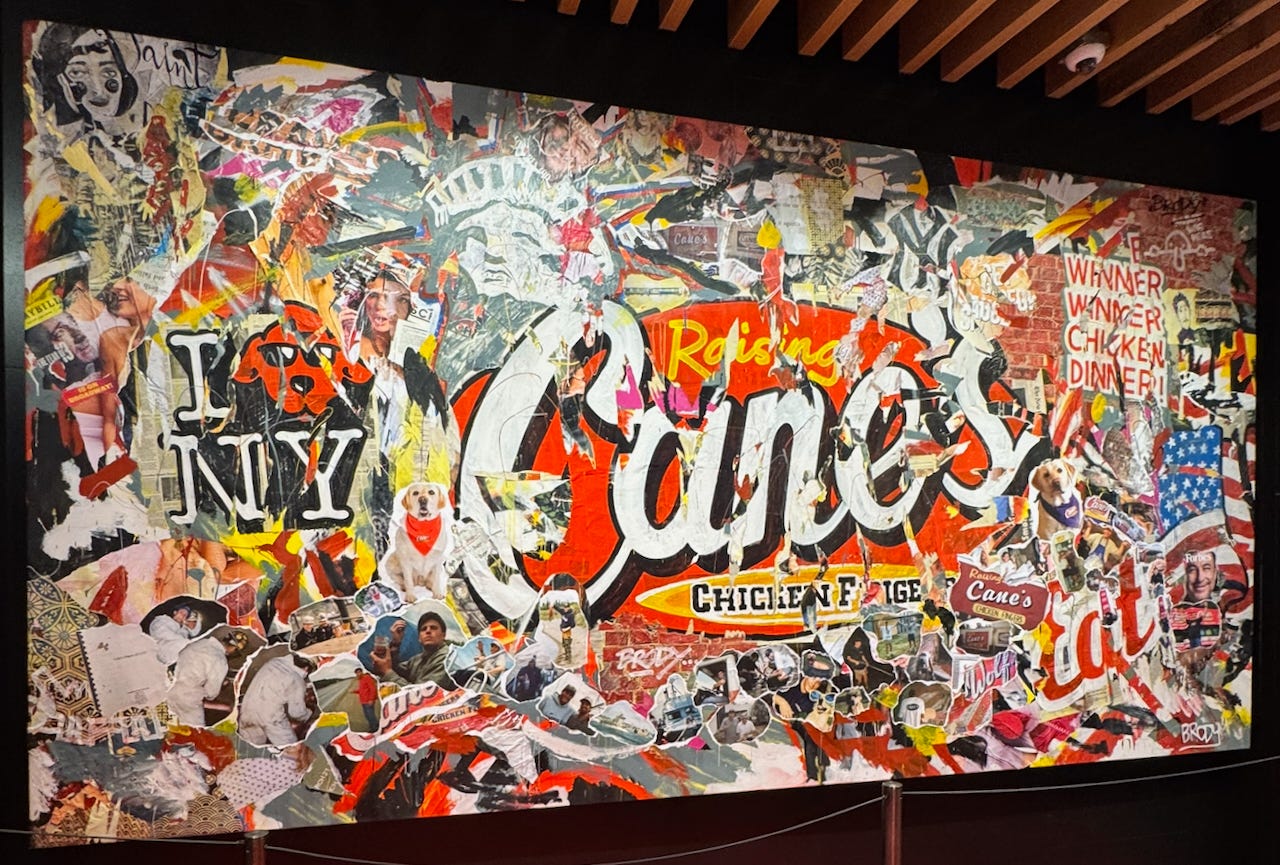
Described by Brody as a product of “admiration and respect for [his] friend Todd Graves,” the chain’s founder and majority owner, the piece supposedly charts Graves’s 30-year odyssey turning a single humble fast food joint in Baton Rouge, Louisiana into an international juggernaut with more than 1,000 locations daisy chained across at least six countries. But as the Queens-born-and-bred Brody outlines, neither he nor his mural would exist without the influence of the Empire City:
“Layered with found wheat-paste fragments, torn advertisements, and weathered street ephemera that I have gathered throughout New York City along with the playbill from my Broadway debut in The Fear of 13 - the work echoes the grit, perseverance, and entrepreneurial spirit that defines Graves’s journey, the spirit of NYC, and an urban aesthetic that has always spoken to me growing up here.”1
This is all a florid way of saying that Cane’s Anthem follows the lineage of several works featured in Made in America, Brody’s 2025 solo show at the Madison Avenue location of Eden Gallery.2 Full of classic cartoon characters strapped up with weaponry, wheat-pasted magazine clippings and scrawled phrases with all the faux edge of a Fisher Price knife set (see: “I ❤️ TOXIC WASTE”), and appropriations of first-thought-only-thought art references like Jean-Michel Basquiat’s crown icon, it was the street art version of the worst finance guy you know recording a rap album.
On one hand, Made in America and the press flurry around it—capped with a feature in the New York Times, no less—transformed Brody into the art world’s lankiest punching bag. Amping up the ire were a few knee-buckling results for his works at benefit auctions: €250,000 (around $275,000 at the time) in 2016 for Tiger on Last Legs, a type of jungle scene that you can see superior versions of airbrushed onto vans owned by old stoners, and $425,000 in 2025 for a collage of Marilyn Monroe in his (ahem) mature style.3
Brody joins a lineage of actors, filmmakers, and pop stars vying for respect as studio artists, from Jim Jarmusch and John Waters to Brad Pitt and Sylvester Stallone. Some contrarian critics have even argued that Brody bolsters the Horseshoe Theory of Taste, by which some work is so radioactively awful that it loops all the way back around to being genuinely good. 🧲 ⭕️ (I, for clarity, think it’s OK for things to just be bad.)

But Cane’s Anthem also represents an about face for the actor. In a 2025 conversation for Interview, Brody lamented that Americans as a society are (emphasis mine) “inundated with imagery and cartoon imagery and acceptance of all of this fast food and mass media and all of that we’re kind of feeding”—a sentiment he doubled down in an interview with Cultured. He translated this critique onto canvas by including occasional logos of burger and chicken chains, including Raising Cane’s.4
Now, I can’t tell you how to square Brody’s repeated flaying of fast food in his artwork in 2025 with his proud celebration of a fast food chain in his artwork a year later. That is between him, his god(s), and his business manager.💸😇 What I can tell you is that any artist interested in money, mass visibility, or both should listen carefully to any offer from Todd Graves and the colossus he’s constructed from chicken fingers, particularly when it comes to his mandate that each Raising Cane’s location feature a mural celebrating the brand.5
Like Brody’s art practice, the histories of chicken fingers and Raising Cane’s make a convoluted collage. Weirdly, they bring together high-stakes culinary innovation, spontaneous linguistic mutation, and the great American art of the ad jingle.
From the start, Graves’s restaurant concept hinged on serving only five items: chicken fingers, fries, Texas toast, coleslaw, and a “signature sauce” that, like so many others, is just a Thousand Island-esque aioli. But his choice of the nomenclature “chicken fingers”🐓✌🏼is notable, since multiple sources online agree that the chain strictly fries up chicken tenderloins—a vital distinction among poultry purists.
Tracing the chicken tender’s origin leads us to the great income tax-free state of New Hampshire. In 1974, a line cook at The Puritan Backroom, a restaurant in the town of Manchester, pioneered a preparation for the chicken tenderloin, a thin, previously unloved strip of auxiliary breast meat.
The pectoralis minor, as biologists and butchers know the muscle, merely helps hold a chicken’s spine in place on one half of its body, meaning the tenderloin never gets toughened through exercise (hence the name). And since butchers and supermarkets still only sold chickens whole in the US in the early 70s, the tenderloins also had an annoying habit of simply flopping loose whenever a cook went through the hassle of breaking down the carcass. 🪽
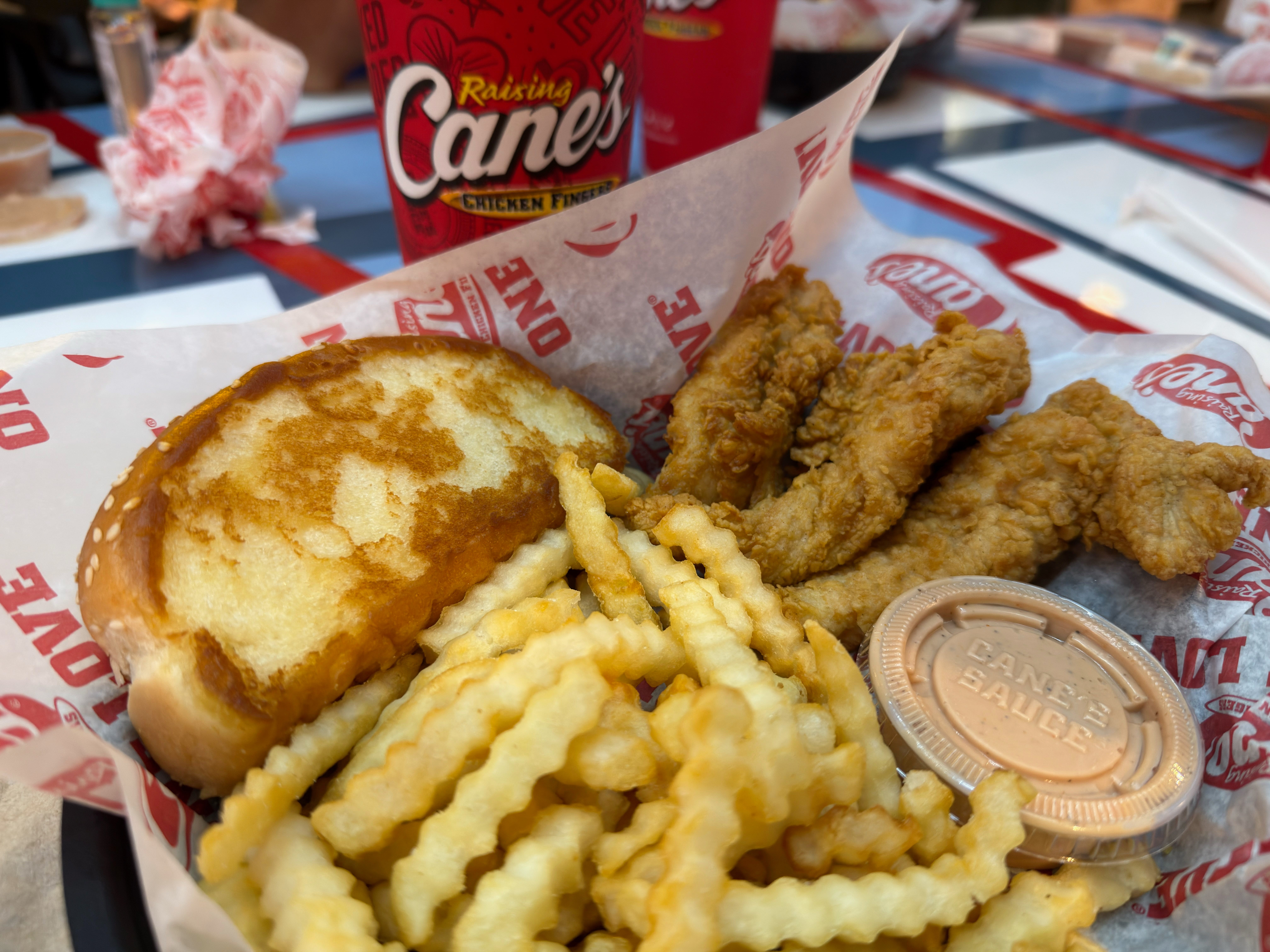
Cue the ingenuity of that Puritan Backroom cook, who was ready to “Live Free or Die” trying to make margins. His solution? Marinate the tenderloins in a mixture of pineapple juice and spices indebted to the stone fruit-based “duck sauce” most commonly served with egg rolls in American Chinese restaurants, then batter and fry ‘em up. The result eventually became a new signature dish for the Puritan Backroom, which now serves four to five tons of tenders a week, according to ownership.6🤩
Yet it took years for the chicken tender to become a national sensation. Enter Burger King: after five years spent simmering 😤 over the runaway success of McDonald’s Chicken McNugget, BK clucked back in 1985 by releasing its Chicken Tenders (capitalized here for a reason).
The product was an instant sensation. Tenders were marketed as 100% white meat rather than a Frankenstein’s muncher of agglomerated, artificially shaped, and fried poultry parts. Burger King even crowed about the difference with a $20 million ad blitz soundtracked by the uncannily soulful jingle “Ain’t Nothing Like the Real Thing, Baby.” 🎶 The chain quickly sold out of tenders nationwide, forcing executives to temporarily halt the campaign. 🛑🍗
But Burger King didn’t just brand and mass-produce chicken tenders. It also registered “Chicken Tenders” with the US Patent and Trademark Office, arguing that the phrase was primarily recognized by consumers as a specific product pioneered by, and exclusively available from, one corporation.7
So how did we go from Chicken Tenders™️ to its widespread use as a generic phrase? The short answer is that the evolution of language can destroy trademarks. In this case, it seems that US consumers’ understanding of the magic words shifted from a particular corporation’s particular product, to just another poultry part.8 Contributing to this transition were advancements in butchering technology that led to chickens being piecemealed into specific cuts, including tender(loin)-only packets.
By 2024, Pete Wells reported, the tenderloin had become the most expensive cut of chicken in America on a pound-for-pound basis. And their popularity has only revved up in recent years, with industry data showing Gen Z consumers flocking to the tender/finger more frequently than any other fast-food chicken format.
Given that Graves launched Raising Cane’s only six years after the Eleventh Circuit Court of Appeals upheld BK’s trademark on Chicken Tenders, it’s no surprise that he went with “chicken fingers” instead of challenging Goliath over verbiage. And by god, has that turned out to be a wise business move.
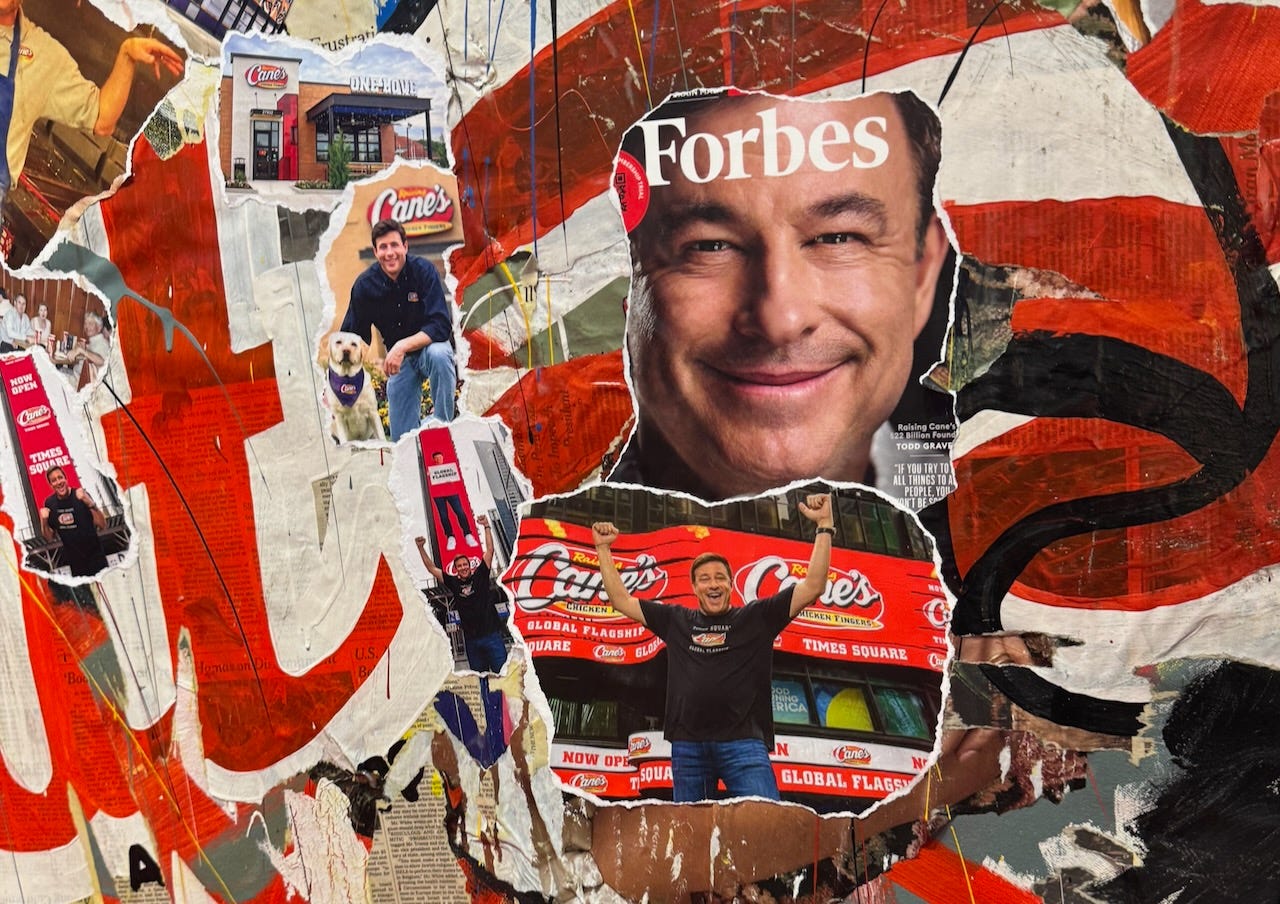
This year Forbes estimated Graves’s net worth at a hallucinatory $22 BILLION, making him one of the 150 richest human beings in the world.9 Again—and I cannot stress it enough—THIS IS FROM CHICKEN FINGERS. Don’t get me wrong, I respect every entrepreneur with a strict vision and the will to carry it through (provided it’s not hurting anyone in ways that they don’t want to be hurt). But if we as a civilization didn’t already have enough reasons to consider temporarily pausing to re-evaluate this whole thing from first principles, the cause and effect here tips us over the limit.
For better or worse, I hadn’t reached this conclusion after I visited Raising Cane’s Times Square flagship to see Cane’s Anthem, despite that journey including an all-day live DJ set cranked to volumes typically reserved for psychological warfare (sorry to Lykke Li’s “I Follow Rivers” [The Magician remix], you deserved better in 2026) and a mob of beaming Cane’s fanatics lining up almost nonstop to shoot selfies with Brody’s work—all on a Monday at approximately 5pm. That’s because the scene clarified that this collaboration is satisfying the desires of all parties involved, whether directly or indirectly.
The art world once again got an excuse to feed Brody’s studio practice through a butchering mechanism as efficient and unforgiving as any that the modern meat-processing industry has ever concocted. → Graves got his mural by hiring a friend and celebrity whose love-hate profile as a sometimes-artist would only reinforce Raising Cane’s pop cultural brand equity. → And Brody gets the continual ego boost of seeing hundreds of fans a day who don’t give a fuck about art industry airs happily posting his work all over their socials as if it’s the greatest, most satisfying thing on earth besides… well, the chicken tenders being served up by the ton week in, week out around the globe, from local diners and fast food counters to would-be buzzy restaurants and private chefs’ tables.
Just as a fried tender falls short of being the most evolved culinary expression of the chicken, none of the activity above shows any of us at our best. But whether in the kitchen or in the wild, the truest reflection of who we are and what we want seldom does.
Tim Schneider is a writer, speaker, and private consultant specializing in the systems shaping the fine art and collectibles industries. You can subscribe to The Gray Market here, his conversation-starting newsletter about the art industry’s collisions with other cultural sectors and non-art businesses.
Thanks for reading this inaugural guest post! I’ll be back in two weeks with a deep dive into Brâncuși, his irate cooking, and a diasporic chicken dish that’s as terroir based as champagne.
ICYMI, The Fear of 13 is a stage adaptation of a documentary that followed the events leading to the exoneration of inmate Nick Yarris (played by Brody) after he spent 22 years on Death Row for crimes committed by someone else. That the only apparent connection between the play and the mural is that both are things Brody did in the vicinity of Times Square arguably tells you everything you need to know about the level of thematic rigor, if not general coherence, permeating his studio practice.
As of my writing, a banner on Eden’s website informs visitors that “After 25 years EDEN Gallery is now EDEN, House of Art.” I am ignoring this proclamation because describing a business that principally sells artwork as a “House of Art” instead of a gallery or dealer(ship) would create more confusion than it’d clear up.
Granted, the art trades generally covered those big numbers minus the crucial caveat that bidders tend to knowingly get nutty at benefit auctions. The point, after all, is to maximize the money going to a good cause.
As noted by Emily Colucci noted in her review of the show for the proudly pro-camp outlet Filthy Dreams. An image of the work in question, with Betty Boop as its centerpiece, is included in the Cultured piece if you click through.
This design requirement comes from a literal artifact of the first Raising Cane’s. While renovating the interior, Graves discovered a mural from one of its former tenants, a bread bakery named Wolf’s. He “took it as a literal sign that this was going to work,” claims the Raising Cane’s website—and not only pulled color and wordmark inspiration from the Wolf’s mural but also pledged to put one for his own brand in every store he might eventually go on to open.
For more on the history of the Chicken tender see Pete Wells, “How Chicken Tenders Conquered America,” NY Times (October 1, 2024).
The chain even successfully sued Pilgrim’s Pride, a Floridian poultry processor, in 1988 to protect its intellectual property. The Puritan Backroom seems to have glided under the radar until BK allowed its rights to “Chicken Tenders” to lapse in 2016.
The terms of art for a verbiage’s voyage from the specific to the generic is “genericization” or, if you’d like a more violent option, “genericide.”
The exact ranking fluctuates because Forbes now updates its net worth approximations daily. Between August 12 and August 15, for instance, Graves rose from #145 to #123. For comparison, Forbes estimated on August 15 that Andrew Cherng, who founded Panda Express with his wife Peggy in 1983, was worth only $6.7 billion, making him Earth’s 588th-richest person.