

What can chickens tell us about Netherlandish art? For the answer, look to Pieter Bruegel the Elder’s Netherlandish Proverbs (1559), a masterpiece of genre painting that is chock-full of more than 120 sayings, from “the herring does not fry here” (it’s not going to plan) to “he who eats fire, craps sparks” (if you do something risky, don’t be surprised by the outcome🧨💩).
The painting also features a handful of poultry-licious proverbs, including:
Who knows why the geese go barefoot? (everything has a reason, even though it may not be obvious)—a more Calvinist version of “why did the chicken cross the road?”
To keep the hen’s egg and let the goose’s egg go (to make a bad decision)
To be a hen feeler (to be stingy, i.e. feeling whether the hen is about to lay an egg before you slaughter it)
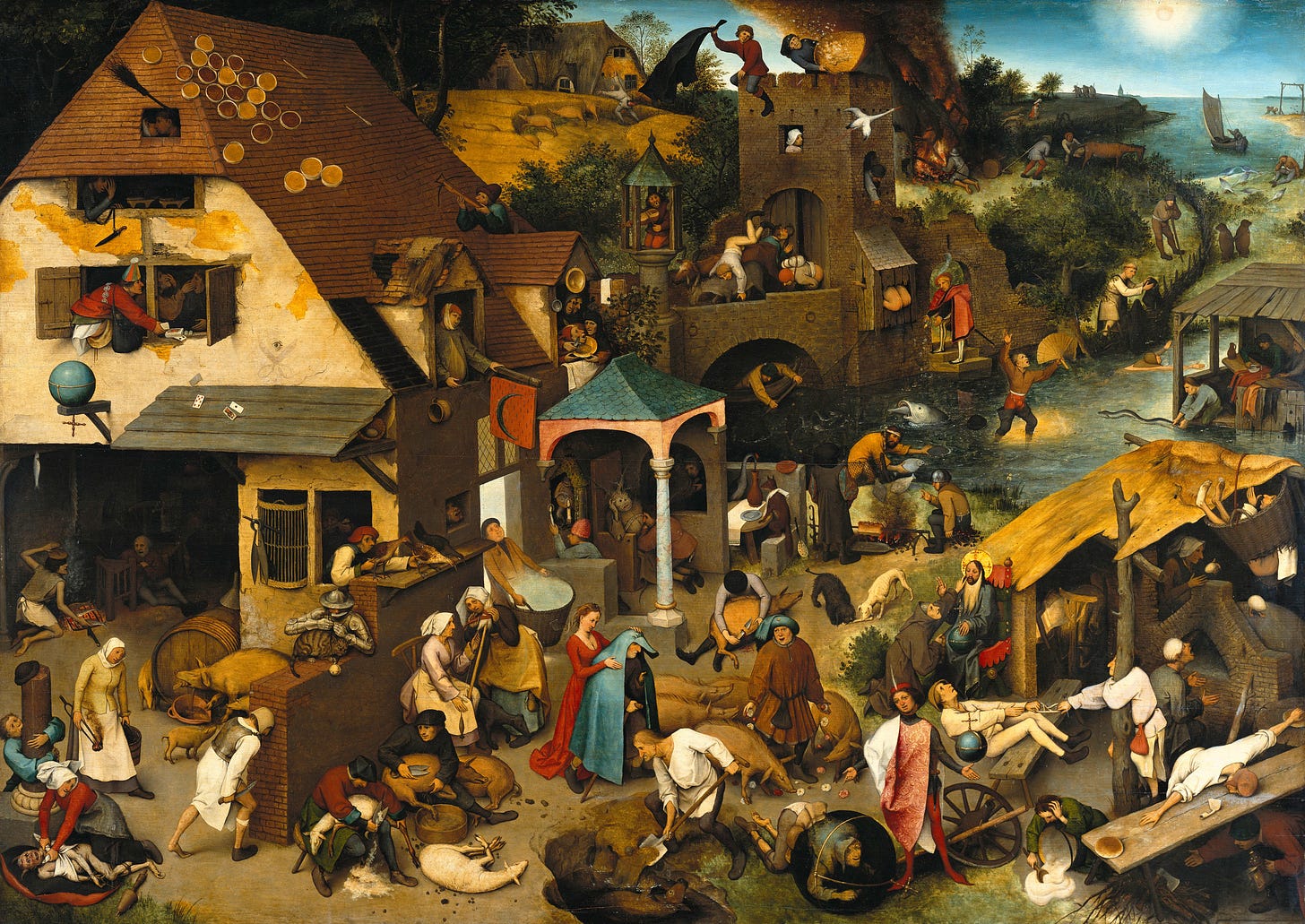
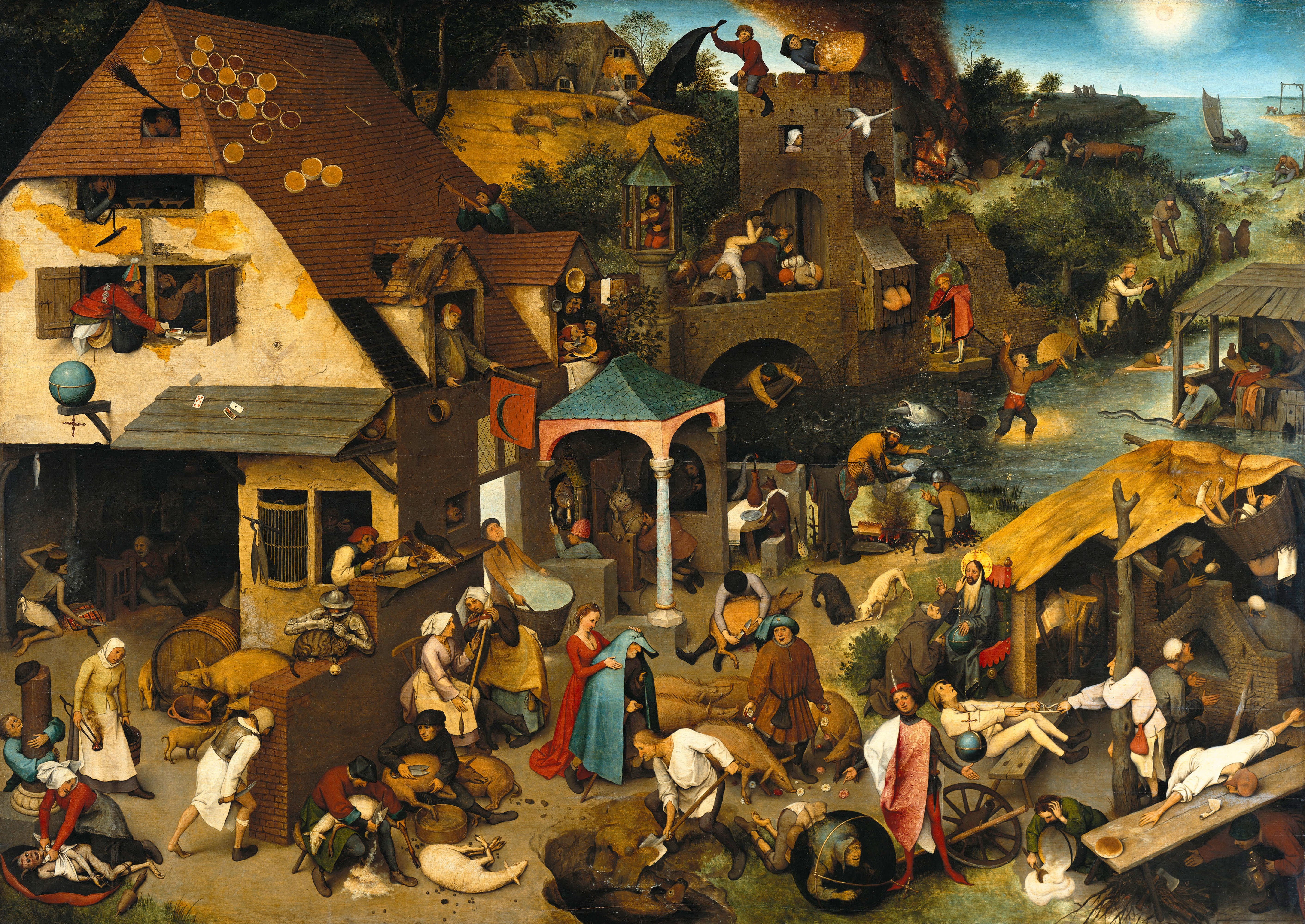
Netherlandish Proverbs (1559), Gemäldegalerie, Berlin, Image in the public domain
Made for an unknown patron, the painting would have appealed to the proverb-pilled literati, who were drawn to these didactic devices for their marriage of wit and persuasion with ancient Greek and Roman philosophy. While proverbs had been embraced by orators and writers in clerical, courtly, and religious settings since the late medieval period, vernacular proverbs became prevalent through publications such as Erasmus’s Adagia (1500) and artworks such as Frans Hogenberg’s The Blue Cloak (ca. 1560)1—largely considered the predecessor to Bruegel’s dense masterpiece.
Paintings such as Netherlandish Proverbs would also have appealed to contemporary patriotic sentiments. The art historian Margaret Carroll suggests that, against the backdrop of Habsburg Spanish rule in the Netherlands, Bruegel’s compilation of vernacular proverbs would have been received as a response to “emerging ethnic and political self-consciousness.”
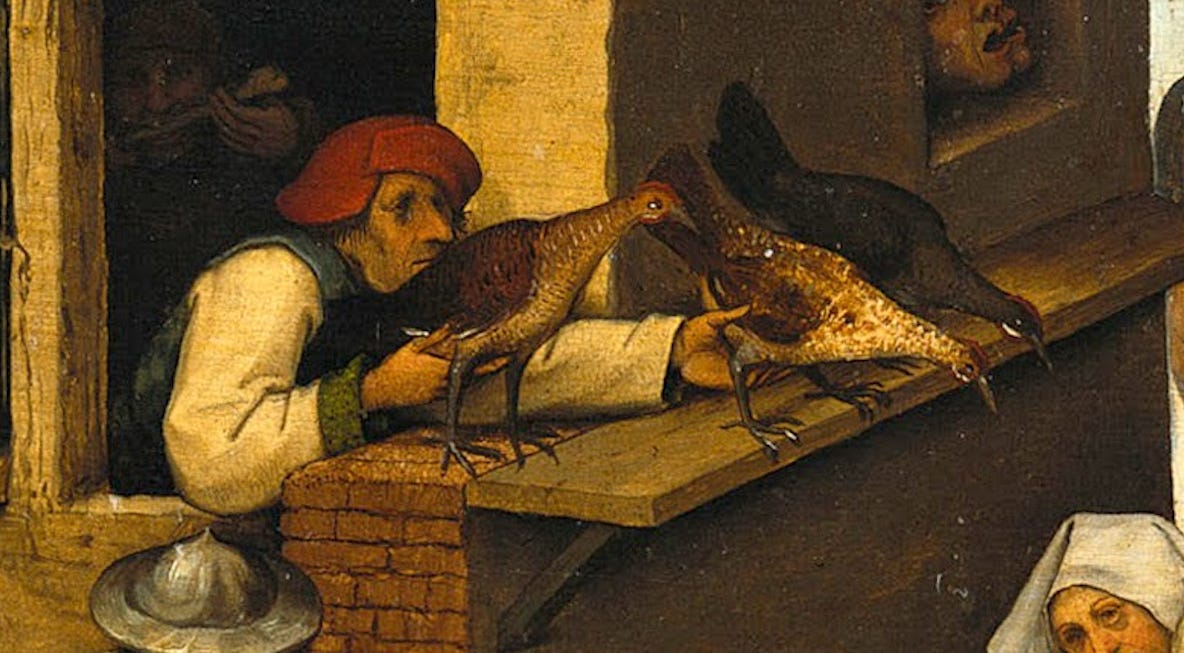
This man is really feeling the hen 🫴
Even though the painting was a mirror of Bruegel’s turbulent social and political moment, its satire of wealth, privilege, and the inversion of social hierarchies remain evergreen. In fact, many of the phrases are still easily identified by contemporary Dutch and Flemish speakers, so check out the full list of proverbs before you hit on a lingering member of the Orange Army or ascendant Red Devils this World Cup season.
Long before Julia Child famously said that “the only real test of a good chef is a perfectly roasted chicken,” the gourmand Jean Anthelme Brillat-Savarin declared, “one becomes a cook, but one is born a rôtisseur.”2 The roast chicken at The Fly proves that they’ve got some born roasters in their Bed-Stuy kitchen.

yom
As someone who’s chased rotisserie chickens in more than 30 different countries, The Fly is the gold standard. They don’t have the advantage of using rare breeds like poulet de Bresse or Yeonsan Ogye, nor does the stainless-steel tray presentation come anywhere close to the $250 baroque horror that is the “Chobster”, a confusing combination of chicken and lobster at Daniel Boulud’s Maison Barnes, presented in vintage lobster “armor.” 🦞⚔️

Incredible sensory play tray
According to an Eater article from 2019, the armor-less chicken at The Fly is dry rubbed with Indian fennel, coriander, Spanish paprika, garlic, Aleppo pepper, and Greek oregano, then finished with tomato jus and olive oil. It arrives soaked. It squelches, and you can’t tell if it’s skin, thigh, or breast melting on your tongue like a savory flan, gliding from sweet to umami in one titillating stroke. Amid the rotisserie chicken wars in New York, where a half chicken can get up to $80-plus, The Fly charges a tidy $34, which is still both obscene for non-NY standards and hardly more than two happy-hour martinis with tip.
The humble poulet rôti is a relatively new addition to culinary history. Humankind has been cooking animals on a spit since the dawn of time, but prior to the Industrial Revolution, roasting jacks were sometimes powered by water (check out Cragside House) or even by a special kind of small dog called a turnspit dog, a teeny-tiny breed that ran on a wooden treadmill to make sure meat roasted evenly.3 🥹

Taxidermy of “Whiskey” the turnspit dog. Abergavenny Museum, Wales.
Up until the 19th century, however, other game birds like geese, duck, and pheasants dominated the spit roast. Chicken was largely a luxury meat reserved for special occasions or eaten as the product of cockerels and unproductive hens culled from the laying flock (see: the “hen feeler”). It was only after WWII, that industrial farming and the invention of the electric roaster together demoted the roast chicken from a luxury item to a mass-market dish.
Don’t get me wrong, I love a roast chicken in a bag. But if you feel like you’ve been tossing feathers in the wind, and don’t want to be a hen feeler, try the roast bird at The Fly.
Dish Rating: 🐓🐓🐓🐓🐓 / 5
If you were hentertained by this post, help this free newsletter fly the coop:
Also includes absolute bangers like “he is beaten by a spit without having eaten from the roast” (one is falsely accused) and “this beer has not been brewed for the geese” (one is entitled to it). Side note: in 2021, Ant Brew in Finland released an imperial stout brewed with goose poop… feels like a beer that’s brewed more for geese than people.
“On devient cuisinier; mais on naît rôtisseur,” from Physiologie du goût (ca. 1825).
If you find yourself in New England, the Salem Cross Inn still operates a 17th-century roasting jack—just think of the centuries of seasoning on that.