

If you were an 18th-century Swedish count and stumbled upon court ladies getting dressed, how would you memorialize your voyeurism? If your first thought was “write about it,” your freak is nowhere near that of Count Carl Gustaf Tessin, who commissioned an artist to paint all of them as sexy chickens.
Wait what? Behold the Hönstavlan!!
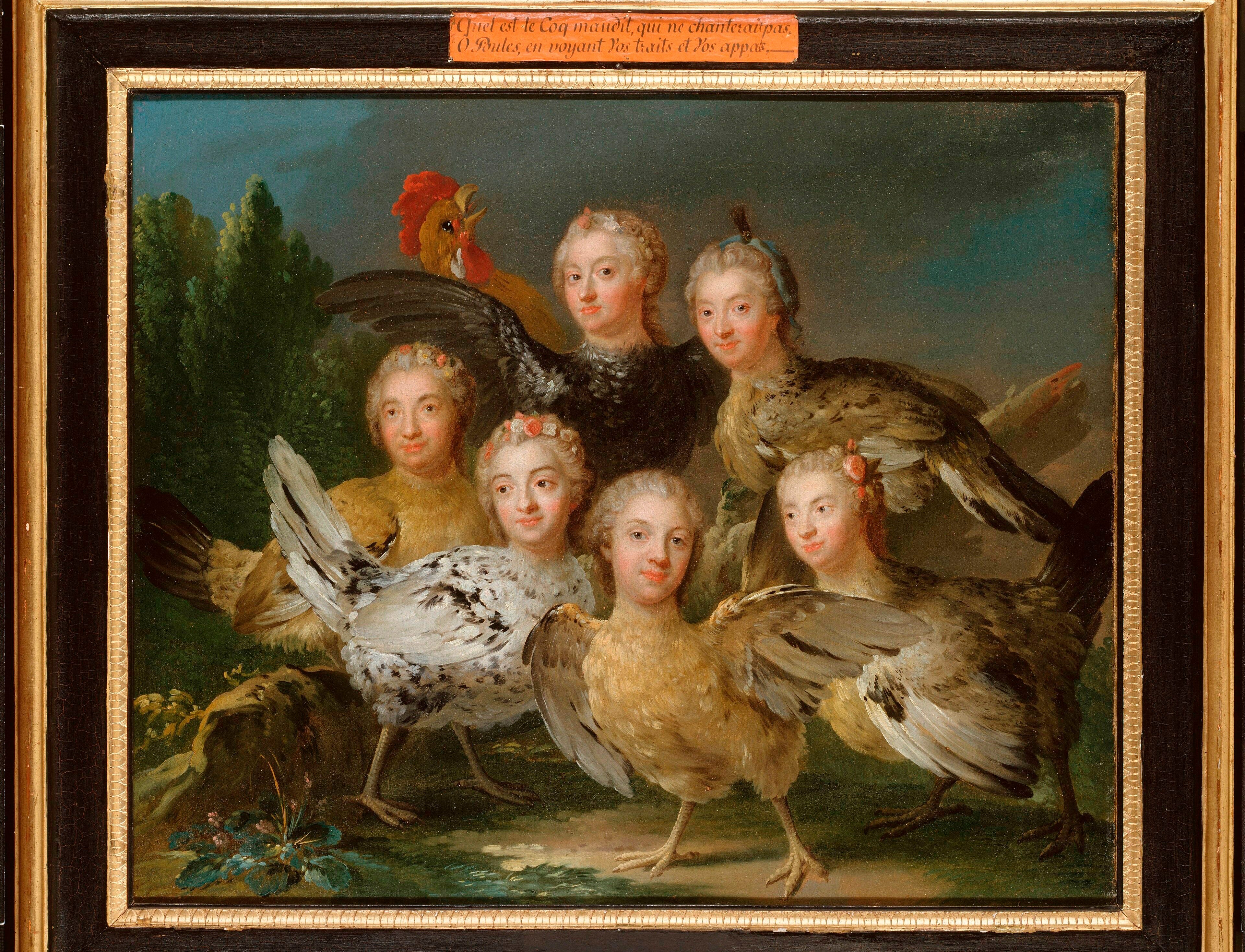
This feathery masterpiece is attributed to Johan Pasch the Elder and was commissioned by Tessin as a Christmas gift to himself.1 Best remembered as an arts patron, collector, and all-around Francophile, Tessin brought continental Enlightenment approaches to art and science to the Swedish court.
He was also an infamous Peeping Tom—according to the Nationalmuseum, don’t @ me—who was inspired after he stumbled upon ladies from the court of Crown Princess Lovisa Ulrika getting dressed.2
And yes, the rooster lurking behind them is supposed to represent Tessin as the…erect cock lording over his mutant flock of six hens.3 Because all of this was apparently too subtle, Tessin added an accompanying French verse that translates as “What accursed rooster would not crow, O hens, on seeing your features and charms?”4 Basically, who would not want to…rise to the occasion, having seen what he saw? 😈
But don’t be fooled into thinking this was merely a private perversion. The resulting painting was presented at a court gathering attended by the hens themselves.5 Tessin even had the image turned into gaming counters (basically like poker chips), as part of his broader efforts to entertain, flatter, and curry favor with members of the court.6 Which goes to show that the “what’s the matter sweetheart, can’t you take a joke” approach has been around for centuries.🤡
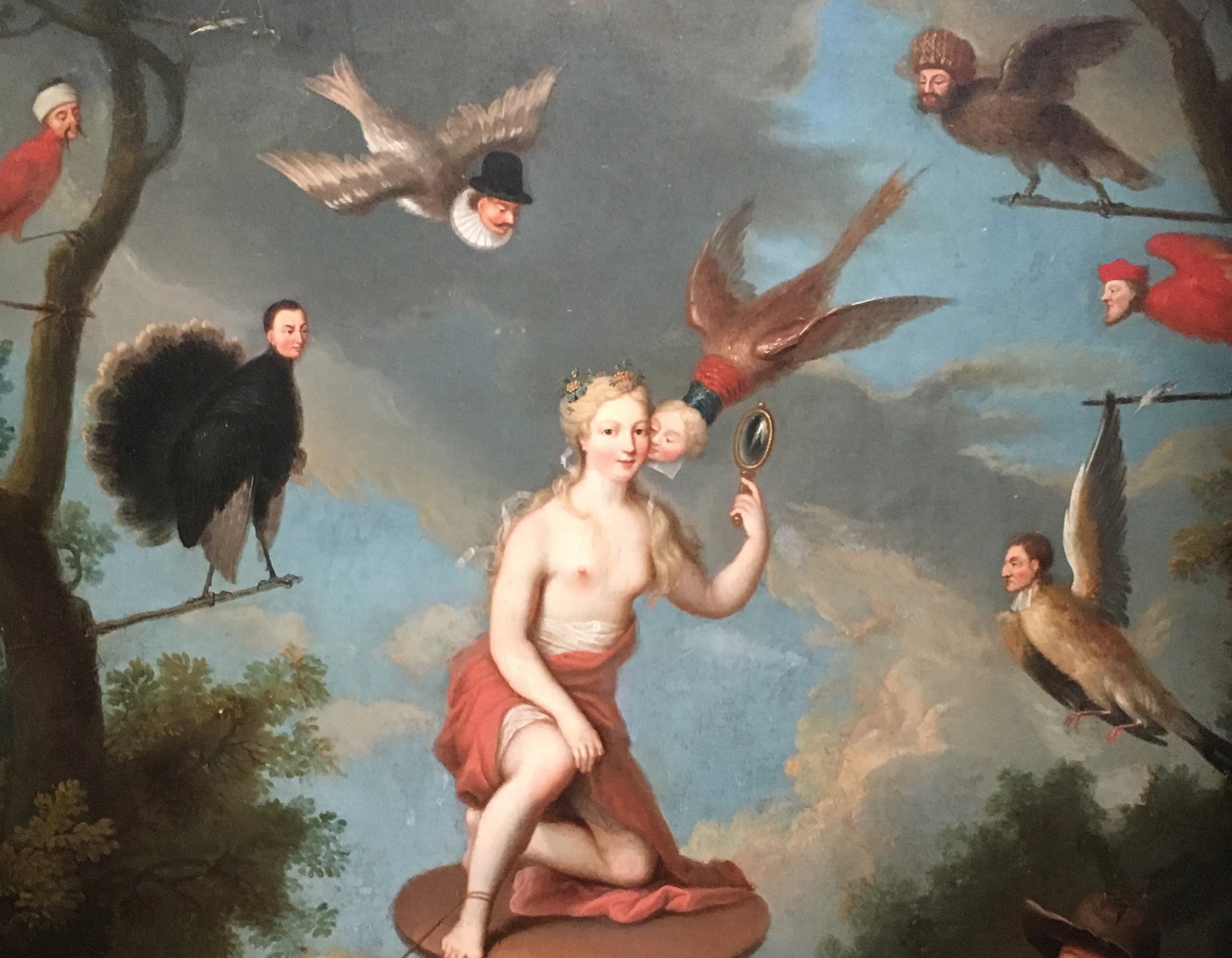
Fortunately for us all, this zoomorphic trope is its own genre. One important prototype is Giacomo Franco’s La Chasse à la chouette, a late-sixteenth-century composition that spawned numerous painted copies.7 Franco’s image refers to a method of owl hunting in which a live owl was tethered to attract other birds. Here, the hunting strategy becomes an allegory warning young men not to fall for a pretty face. 🦉💅

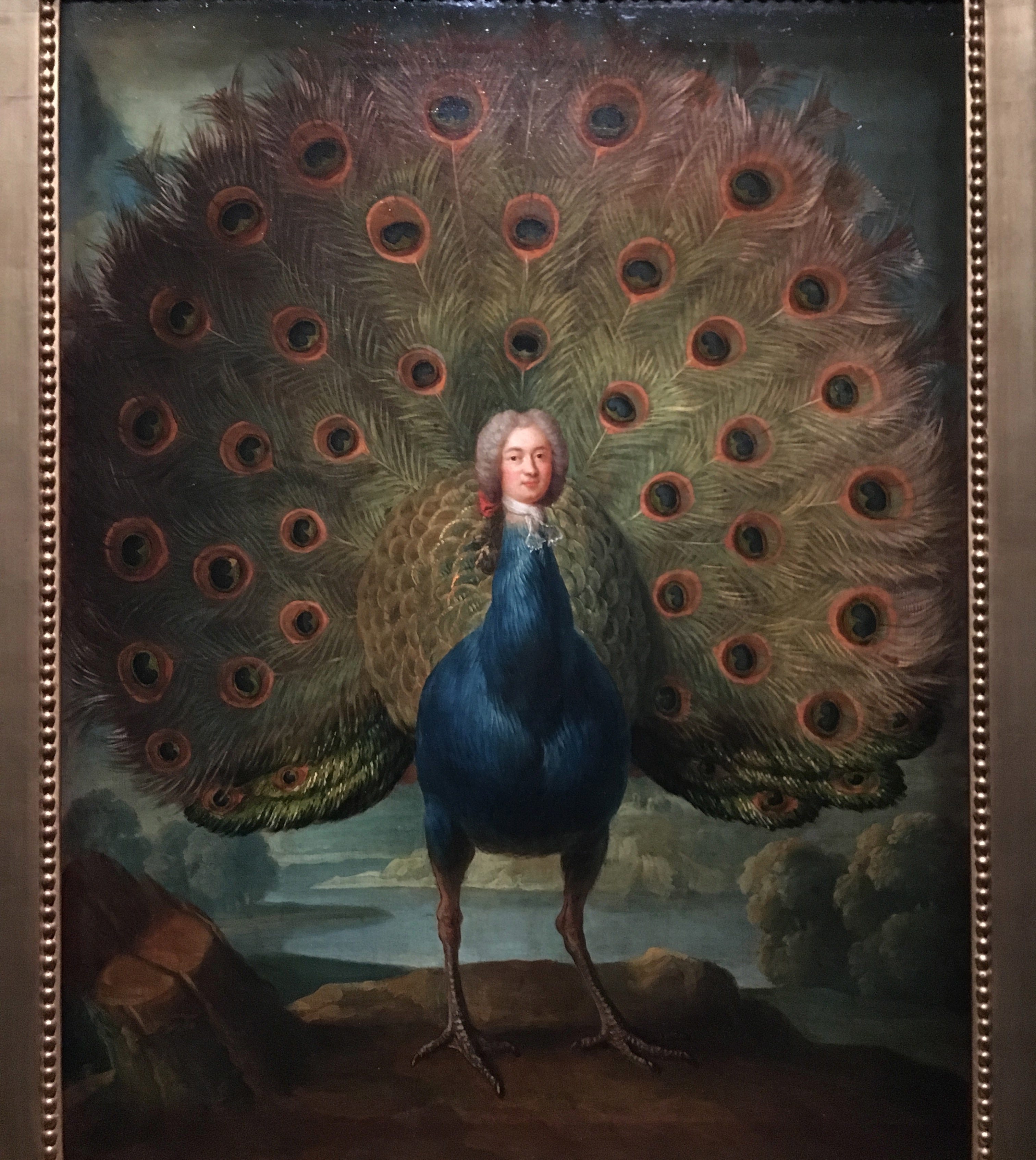
Over time, this bird-human hybrid would recur as an aristocratic in-joke—see Louis-Antoine de Gontaut, duc de Biron, depicted as a peacock, which feels fairly self-explanatory—and eventually into political satire where the “bird brain” insult continues on today.8
.jpg)
If the Hönstavlan is a lady stuffed inside a hen, the Chicken Kyiv is apparently a vessel for anything and everything. Here’s the convoluted history: the dish emerged from a Franco-Russian tradition of breaded and stuffed poultry dishes.9 It is often linked to the Continental Hotel in Kyiv, but by the 1910s, the dish and its recipes were embraced widely by Soviet diners with bourgeois aspirations. These early dishes were made from minced chicken or veal, pounded together with egg, bread, milk, and butter, then wrapped around another lump of butter and fried into something resembling a meat croquette.🧈🧈🧈
By the 1930s, this artery-busting ball crossed the pond to appear in Russian-themed restaurants in Chicago and New York. In 1946, The New York Times published their Chicken Kyiv recipe, helping the dish shrug off its haute-cuisine origins and become a synecdoche for a pan-Soviet cuisine (and in turn, the Sovietization of Ukrainian cuisine).10
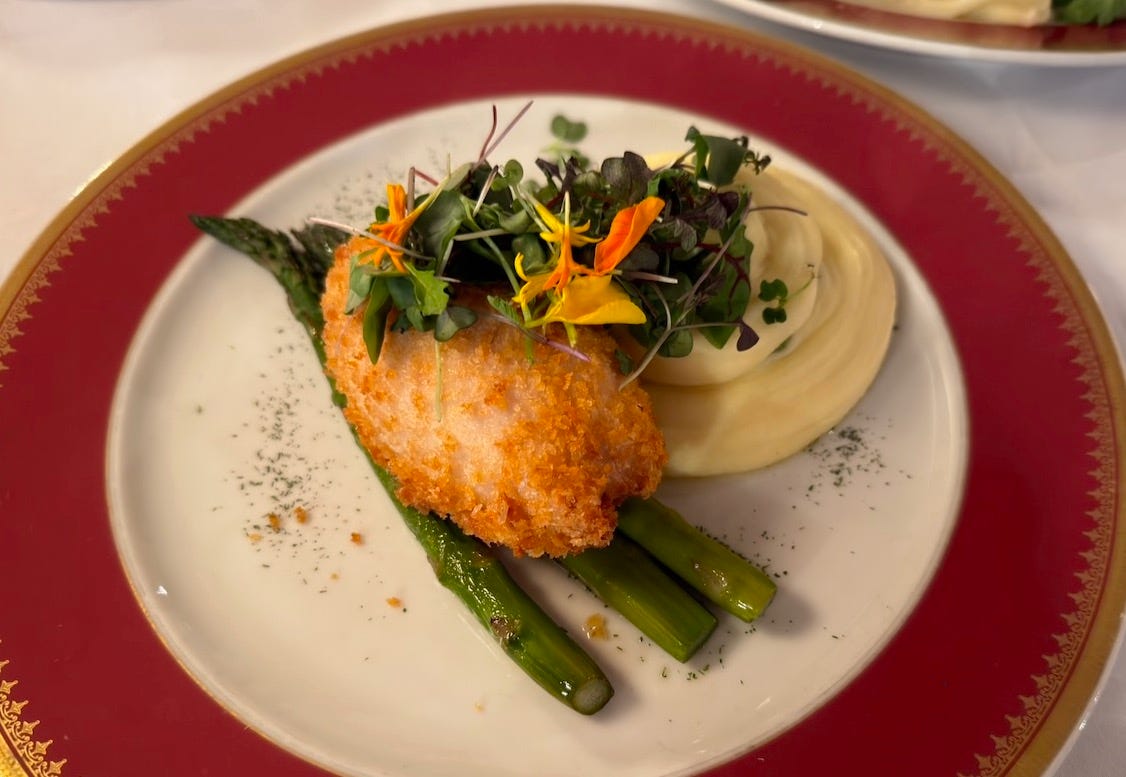
I recently ate Chicken Kyiv at two places that are themselves a hodgepodge of cultural referents. The first was at Tatiana, the Brighton Beach stalwart, for our friend Tatiana’s birthday party, where I vaguely remember chomping through some chicken between bouts of dancing and drunken clapping. The second was at Aleksandra, a Russian-themed restaurant aboard a Tallink overnight ferry connecting the Baltics.11 Both restaurants served the long-Westernized version: breaded chicken breasts rolled around garlic-and-parsley butter, far removed from those early versions from the Soviet Union.
The dish’s current ubiquity, however, probably owes more to Marks & Spencer than to any Soviet chef. A young product developer, Cathy Chapman, suggested a ready-to-cook meal that was breaded and flash fried. The British department store launched its ready-to-cook “Chicken Kiev” in 1979, and it sold so well that M&S established a separate factory dedicated to its production. In the decades since, it has become a ready-to-eat staple. And I am horrified to report that 2023 mutations of the dish at Iceland (the frozen food grocer in the UK) have included Nacho, Tikka, and Hoisin.😵💫
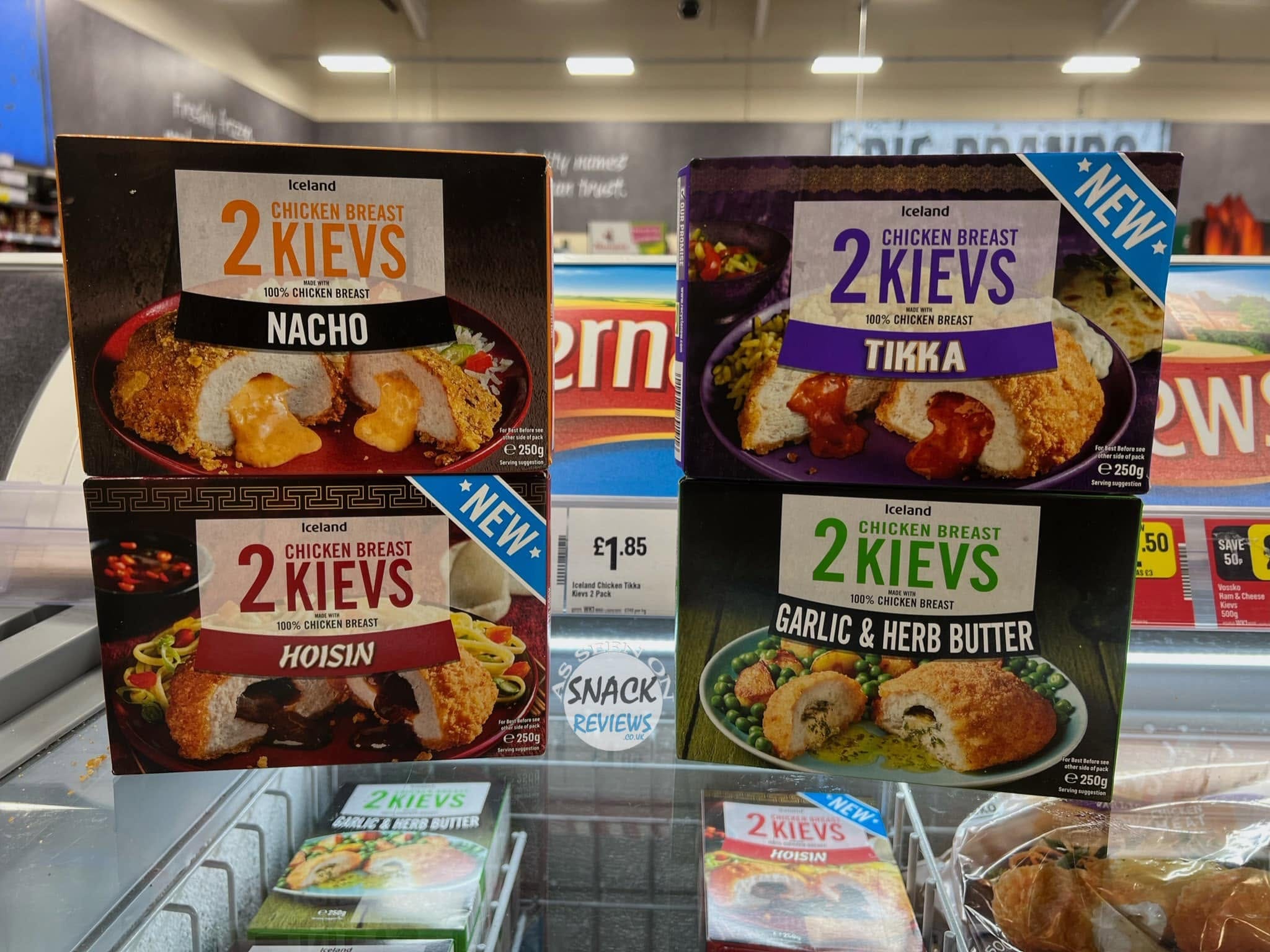
Then again, what dish could be more emblematic of the past two centuries of imperialism? While it originated as a traditional continental cuisine designed for aristocratic tables, it then passed through the Russian Empire and the Soviet project of standardizing national cuisines, to end up serving the last empire still standing: the capitalist demand for convenience.
So go forth and stuff a Chicken Kyiv with Mango Chutney Butter. Fill that saucy unit with gochujang and kimchi. Convert it into a cheese dip. Turn it into whatever your cardiovascular system can withstand. And should you encounter some hot people you would like to stuff inside chicken bodies, please make sure you paint them as the plumpest, fluffiest, and sexiest chickens possible.
Tatiana’s and Aleksandra’s Chicken Kyivs: 🐓🐓🐓🐓/5 for ambiance: burlesque at the former, red velvet interior lit by midnight sun at the latter.
For more see Birgitta Martinius, 1700-tal: Carl Gustaf Tessin på Läckö (Nationalmuseum, 2005), and Knut Hendriksen, “Ett ‘tillfällighetsstycke’ av Johan Pasch,” Konsthistorisk tidskrift 42 (1973), 77–81.
The six women were: Ernestine von Grisheim, Henrica Juliana Liewen, Charlotta Fredrika Sparre, Agneta Margareta Strömfelt, Ulrika Eleonora Strömfelt, Catharina Charlotta Taube. This reminds me of one time when I visited a collector that insisted on showing me his collection of early modern art depicting women getting enemas.
Hens as stand-ins for single ladies. [i.e. hen-do].
“Quel est le Coq maudit, qui ne chanterait pas, Ô Poules, en voyant vos traits et vos appas.”
The painting was actually presented at a conveneing of De små mästarinnors akademi, a private society within the Swedish court.
See Daniel Fehrman’s game tokens from ca. 1750.
The strategy, called Caccia alla Civetta, is a bird hunting technique where you tie a live owl or a decoy to a post, triggering a mobbing instinct in birds. For more on Franco, see Sara F. Matthews-Grieco, “Satyrs and Sausages: Erotic Strategies and the Print Market in Cinquecento Italy,” in Erotic Cultures of Renaissance Italy (2010), 35.
*From the exhibition Carambolages, (Grand Palais, 2016). Photo by the author.
For more on French influence on Russian cuisine see Darra Goldstein, “Russia, Carême, and the Culinary Arts,” The Slavonic and East European Review 73, no. 4 (October 1995), 691–715.
Edward Geist, “From Khrushchev’s Kulish to Chicken Kyiv: How Soviet Power Redefined Ukrainian Cuisine”, The Soviet and Post-Soviet Review 50, 2 (2022): 143-161.
I would be remiss not to mention how much our visit to Tallinn was enriched by our friend Olga and by the consistently exciting program she has built at Temnikova & Kasela!