

What can $36 million get you? If you’re Kylie Jenner, that’s a whole mansion to share with Timmy C. If you’re David Koch, it can fund a new fossil hall at the Smithsonian National Museum of Natural History. Or, if you’re the Shanghai collector Liu Yiqian, it can buy you one 15th-century Chicken Cup at Sotheby’s in 2014.

Doucai ‘Chicken Cup’. Sotheby’s Sale, April 8, 2014.
The Chicken Cup refers to a specific type of small porcelain wine cup first popularized in China during the Chenghua period (1465–87), with a shape inspired by ancient ceremonial ware. These 15th-century cups are a type of doucai ware, a porcelain technique that undergoes multiple firings to allow cobalt-blue underglaze outlines and colored overglaze enamels to shine through.
The motifs are both historically grounded and engage in contemporary wordplay. Chickens have long been featured in ancient rituals and recur in Chinese portent treatises as well as Song dynasty literati scrolls.1 Beyond this, the cups feature the fowls alongside the cockscomb plant, which apparently sound together like the auspicious phrase “may you continuously rise in rank.”2

A chicken wine cup in the 1676 edition of Sanli tu, a 12th c antiquarian text
For these august-to-charming reasons, the wine cups commanded astronomical prices from day one and continued to be coveted by emperors. The director of the imperial kiln in the Chenghua period reportedly described them as “rarer and more precious than dragon spoons or ancient vessels of bronze,” and noted that “wealthy people prefer them to books or any other antiques.”3 Two centuries later, the Qing scholar Cheng Zhe wrote, “a cup of tea in such a Chenghua cup is dearer than wine…and dearest and most appealing of all are the so-called chicken cups with pecking and confronted chickens.”4
The aforementioned Shanghai collector Liu Yiqian—who paid the $36 m with his Amex Centurion Card (for the points!!)—did drink tea from the cup, apparently to make some kind of a point about Chinese art collectors. Though given that he’s now offloading his collection, perhaps the true moral is that no one escapes the poultry-industrial complex unscathed.
I have been feeling like a confronted chicken in my quest to locate some kind of a chicken martini.5 🍗🍸
As a tax-paying denizen of the Frankentini capital of the world, a.k.a. New York, I’m no stranger to the maximalist ’tinis. This long list includes the garlic bread martini at San Sabino, the MSG martini at Bonnie’s, the Feta Brine Martini at Mr. Melo, the Sour Cream & Onion Martini at the Corner Store, the Pizza Martini at Bar Valentina, the Borscht Martini at the Russian Samovar, the kimchi martini at Golden Hof, an oyster martini at Bistrot Ha, with an honorable mention for the Fish Sauce Vesper at Smithereens.
While there is apparently a McNugget tini currently being rolled out to the ultrarich in the East End, the “chicken-tini” is still elusive for those of us on this side of Long Island.
Bar Snack no longer serves the bouillon-flavored, chicken-chicharron topped Boat Snack Martini, although my visit was worth it to witness the bartender gamely respond to another patron’s prompt for a drink “that pairs well with nicotine gum.”
Instead, there are three kinds of currently à la carte chicken-adjacent martinis in New York: a butter chicken-flavored martini at INDN6, a karaage martini at Shinji7, and, finally, the yakitini at Sip, the downstairs savory Valhalla of Sip & Guzzle.
I personally trekked to Sip, an underground den of tech bros, tourists, and Lean-and-Tan-WASPsTM trying to curry favor with their temporarily disillusioned daughters at NYU. The menu identifies three ingredients for the $28 Yakitini8: dirty martini, binchotan, and schmaltz—none of them ingredients in and of themselves but a combination of cooking processes. When pressed, the bartender told me that it’s a vodka and shochu mix clarified in chicken fat, and served with a freshly torched single piece of green onion, pre-doused in tare and chicken fat.
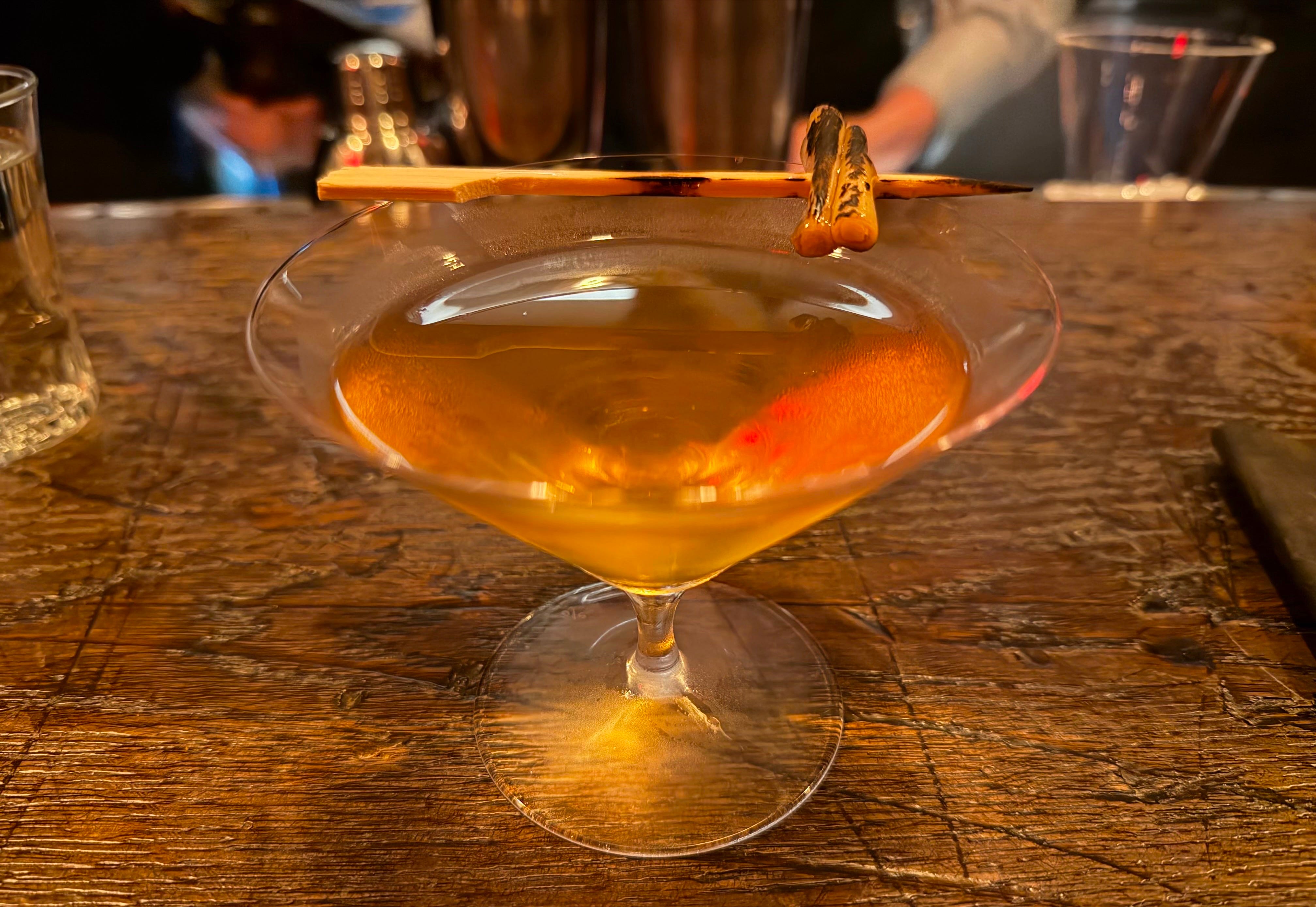
Behold, the yaki-schmaltz-tini
Your experience of this cocktail will depend greatly on when you decide to eat this fragrant garnish. Without it, the cocktail tastes like the best alcoholic chicken broth; after it, it transforms into drinking shochu with the backwash of someone who has been eating yakitori all night long.
Is it a better cocktail than the uni sour that my curiosity made me order at Corima? Sure. Would I like to see how many pounds of chicken-terrine topped “fantasy salad” $28 will get me at Tashkent’s buffet just two blocks away? That’s an answer for a mayo-enthusiast to answer on my behalf.
But if you owned a chicken cup, you could bring the tcup to Sip and ask them to serve the martini in it (and ask for a side car for volume parity), and it might be like the last scene of Indiana Jones and the Last Crusade. Which character you are in that clip may depend entirely on your net worth.
Rating: 🐓🐓/5
Thanks for reading Irate Chicken! If this post hentertained you, help this newsletter fly the coop!
For more on antiquarian objects including various bird cups, see François Louis, Design by the Book: Chinese Ritual Objects and the Sanli tu (2017).
If you see a blue haired person chucking a chicken and a cockscomb plant into the Gowanus canal, it’s definitely not me.
See A. D. Brankston, Early Ming Wares of Chingtechen (1938), 39.
Cheng Zhe, Rong Cha Li Shuo, translation and quotation taken from Sotheby’s catalogue, The Meiyintang “Chicken Cup,” (2014).
If you want to DIY this, the socials are flooded with viral recipes for chicken broth tinis.
Which is fundamentally driven by its sauce rather than the inherent flavor of the protein, so the butter chicken martini to me doesn’t qualify as a pure chicken-tini.
Which was closed when I was sweating my way around NYC in early July.
Shouldn’t it be called a toritini because yaki means fried and tori is means chicken?