

It was Constantin Brâncuși, not Mick Jagger, who said, “Le Coq c’est moi” (The Cock is me).1
2026 is officially the Year of Brâncuși in Romania, marking 150 years since the sculptor’s birth. The art market has been buzzing accordingly, including the record-setting sale of his Danaïde (1913) at Christie’s NY for $107.6 m with fees. The promo materials even featured the newly single Nicole Kidman circling the sculpture while dancing to David Bowie’s “Golden Years.”🏆💫

But bird really was the word for the Romanian. His interest in avian forms began with Maiastra (1910–18), inspired by the phoenix-like bird Pasărea Măiastră from Carpathian folklore. 🐦🔥✨ In fairytales, the măiastră is a fairy or a princess transformed into a golden bird whose magic song could restore youth—a kind of symphonic Tretinoin🎶🧴—and who, in some versions, turns back into a beautiful woman to lure and punish cheating men.2

Brâncuși spent decades evolving this top-heavy borb into the gleaming obelisk of Bird in Space, trading in the fantastical hot chick for a symbol of aeronautical progress and the human urge to transcend gravity 🧑🩰🚀.3
He approached his Coqs similarly, reducing the rooster to its erect, serrated comb. As was his custom, Brâncuși molded his Cocks in everything from wood (the last surviving member is at the MoMA) to bronze.4

His relationship with birds didn’t end at sculpture. Brâncuși was an avid home chef, famous for roasting chicken in the forge of his Montparnasse studio, making his own pickles and, by his account, buying “steaks by the yard.”5 The playwright Eugène Ionesco recalled being served homemade yoghurt, pickled cabbage, and mămăligă (a type of polenta) with Champagne; after dessert, Brâncuși would sometimes perform a belly dance while his female guests drank Turkish coffee...🕺🤔6
So next time you see a Brâncuși, perhaps at the MoMA retrospective opening this October, consider that somewhere in those pristine modernist forms linger the fumes of extravagant, wine-soaked chicken dinners past.
If Brâncuși spent his life stripping birds down to their essential form, what chicken dish does the same thing? It has to be Hainanese chicken, the gently poached chicken served with chicken-fat rice, broth, and an assortment of sauces.
It turns out that Hainanese chicken is a Qing-dynasty dish as terroir-driven as Champagne. Crucial to the dish is Wenchang chicken, an indigenous breed named for a region of Hainan, the tropical island off southern China. Traditionally, the birds foraged on banyan seeds and coconut pulp, supposedly giving the meat a unique flavor. 🐤🌴🥥🐔 It eventually merged with cooking techniques similar to the Cantonese white-cut chicken preparation, evolving into the recognizable Hainanese dish of today.
Despite its Southern Chinese roots, Hainanese chicken is now considered a Southeast Asian dish, with variations including Thai khao man gai, Vietnamese Cơm Gà Hải Nam, Cambodian bay moan, Malaysian nasi ayam and, most famously, Singaporean chicken rice, with the last two still squabbling over who can claim it as a national dish.7 Each of these versions are served with variations on sauces and aromatics—sweet and hot chilis, dark or sweet soy sauces, ginger, garlic, green onion, and more—but the cooking method remains the same: slow poaching a whole chicken at sub-boiling temperatures 🥶.8
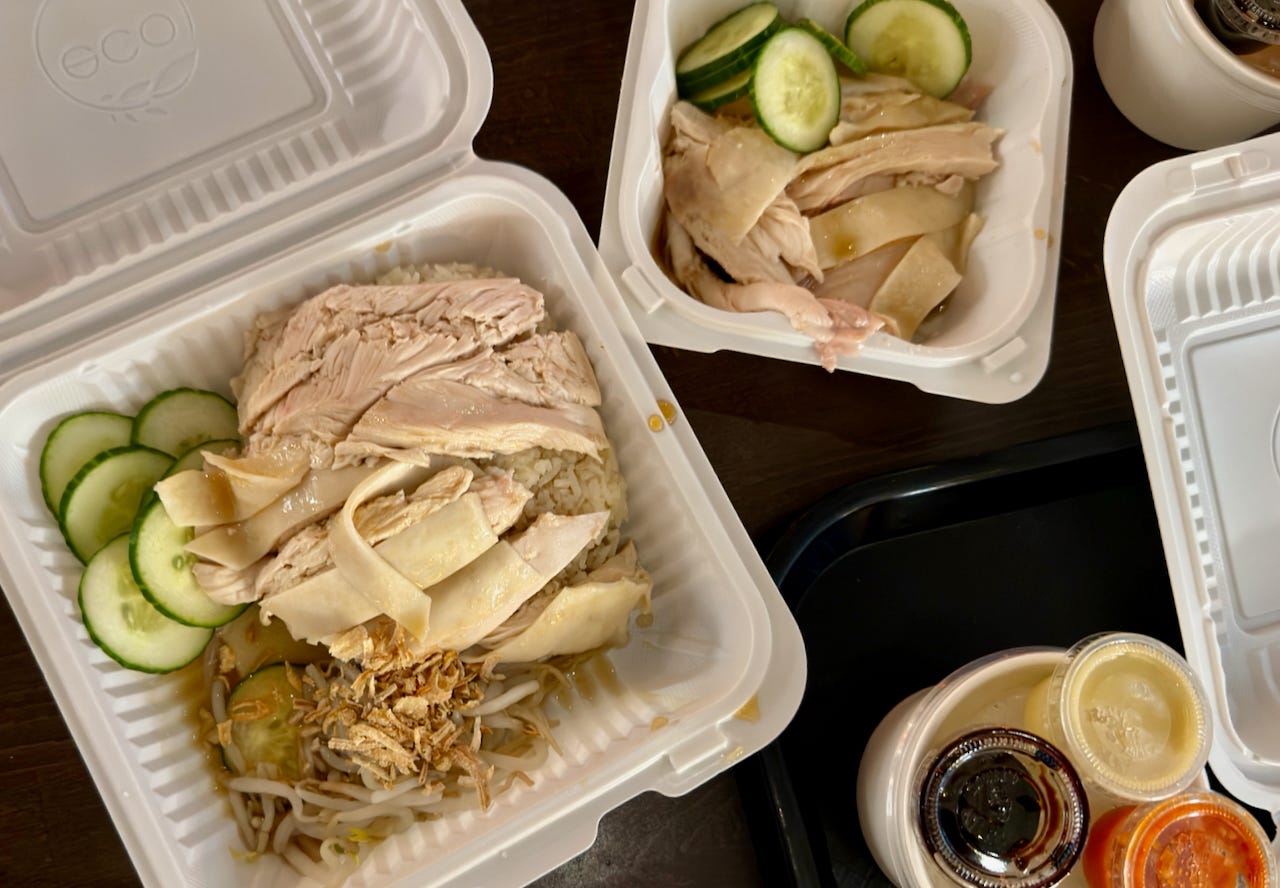
New York has excellent versions at Eim Khao Mun Kai, West New Malaysia, Uncle Ray’s Chicken Rice (recently spotlit in a NYTimes’s “Where to Eat in New York City Right Now”), and Lou Yau Kee. I recently revisited the last with my friend Erik, a fellow Hainanese-chicken enthusiast always game for a chicken side quest. The chicken arrived with salty broth, ginger, soy, sweet and hot chili. Its thin gelatinous skin was akin to a sheet of aspic coddling exceptionally supple meat.
But how did a Hainanese dish spread so widely across Southeast Asia? Like my dating history when I lived in Murray Hill in the early 2010s, we can blame some dude from Connecticut. 🏌️👕
In this case: Edwin Stevens, a Yale grad who went to China as a missionary in 1832, where he would later share a Christian tract with Hong Xiuquan.9 Drawing on missionary publications and local religious concepts, Hong came to identify himself as Jesus’s brother, and established the Taiping Heavenly Kingdom, a theocratic insurgent state that attempted to overthrow the Qing Dynasty. This ultimately unsuccessful Taiping Rebellion (1850-1864), contributed to the broader instability of 19th-century southern China, accelerating the ongoing Hainanese migration (and Hainanese chicken) across Southeast Asia.10
Given this, what is the present state of Hainanese chicken in Hainan? As Saveur reported in 2016, the indigenous birds are still largely raised in traditional ways, including a diet centered on banyan seeds and coconut pulp. But the cooking method never became fixed and local island versions of the dish can be poached, fried, or even salt-baked, underscoring that the true identity of Hainanese chicken lies in the landrace itself.11
So when MoMA’s Brâncuși show opens and you end up arguing with a friend about which Midtown Hainanese chicken is the most “authentic” remember, unless it uses actual Wenchang chicken, it’s all just sparkling chicken…which doesn’t make it any less delicious.
Rating for Lou Kau Yee: 🐓🐓🐓🐓🐓/5
In Other News:
Irate Chicken got a mention in Artnet News!
Did you see Vogue featured Raising Cane’s dogue Cane III? Check out Tim Schneider’s Irate Chicken guest post for more on Raising Cane’s!
I’m excited to read Financial Times’s “How Chicken Conquered the World.”
The next issue will look at a famous philosophical kerfuffle over chicken and a dish tied to the Spanish Inquisition. Thanks for reading and subscribe below to receive the hentertainment directly in your inbox!
Probably a play on Louis XIV purported saying, “L’État, c’est moi.”
Măiastră is also a Romanian adjective meaning something like “masterful” or exceptionally skilled. The magical bird has echoes in other Central and Eastern European fairy tales, including the Brothers Grimm and stories collected by the Romanian folklorist Petre Ispirescu. Fun fact, the photographer Edward Steichen bought Brâncuși’s first Maiastra and installed it in the garden of his home. For more, see Doïna Lemny, “From Maiastra to Brid in Space: The Ins and Outs of the Artwork,” in Brancusi: Sublimation of Form (2019), 110–125.
Brâncuși recalled in 1957, “As a child, I always dreamed I was flying in the trees and the sky. I’ve kept the nostalgia of that dream and for forty-five years I’ve been making birds. It’s not the bird I want to express, but the gift, the flight, the momentum.” Brâncuși, quoted in Claire Gilles Guilbert, Prisme des arts 12 (1957), 7.
Part of what makes dating Brâncuși such a mess is that he not only produced multiple versions of individual works, but continually reworked them, rarely stamped dates, and treated his sculpture and base as modular elements susceptible to endless permutations.
Keith Miller, “Cooking with Constantin Brâncuși,” Apollo, March 2, 2026. See also Brâncuși’s letter of December 3, 1914, to his half-brother Vasile, transcribed and discussed in Florin Colonaș, “Maestrul perfectului simplu,” Observator cultural, December 18, 2014–January 7, 2015.
Eugène Ionesco, “Portrait anecdotique de Brancusi,” in Notes et contre-notes (Paris: Gallimard, 1991), 341–349. Does this actually mean Nicole Kidman should have been belly dancing in the Christie’s promo?
For considerably more on chicken rice and national identity, see Cynthia Gek Hua Chou, “How Chicken Rice Informs about Identity,” in Commensality: From Everyday Food to Feast, ed. Susanne Kerner, Cynthia Chou, and Morten Warmind (2015), 139–50.
For more on regional differences see Chloe Loung, “The Origins of Hainanese Chicken Rice and Its Versions in Singapore, Malaysia and More,” South China Morning Post, April 9, 2026.
The pamphlet was Liang Fa’s Quan shi liang yan [Good Words for Exhorting the Age] (Guangzhou, 1832).
For an in-depth summary of the Taiping movement see Barend ter Haar, “The Religious Program of the Heavenly Kingdom of Great Peace,” Oxford Research Encyclopedia of Religion, 2024.
Kevin Pang, “The World’s Best Chicken Comes From Hainan,” Saveur, March 28, 2016.